
 Techniques and tips for IELTS reading ‘True False Not Given’
Updated: September 2023.
Many IELTS students have problems with True False Not Given and Yes No Not Given texts. Once you understand the techniques and you have fully practiced this type of question, then you will realise they are easier than you think.
IELTS reading is testing your vocabulary so being able to spot paraphrases, collocations, synonyms, and speed reading is crucial. The techniques are the same for Yes No Not Given questions but ‘Yes, No, Not Given’ texts are about the writer’s opinions, not facts.
Make sure you are using authentic Cambridge IELTS materials when practicing because there is a lot of fake material on the internet that is either too difficult or too easy. Use IELTS official books instead.
In this lesson I will look at..
1. What exactly is True, False, Not Given?.
2. 6 tips for TFNG.
3. Example of True, False, Not Given questions.
4. Common mistakes.
5. Practice text and answers.
What exactly does ‘True, False, Not Given’ mean?
True = The statement agrees with the information in the passage.
False = The statement contradicts or is opposite to the information in the passage.
Not Given = There is no information in the passage and there is no way to know.
Key Point: if the information in the text is similar or close in meaning then it is not true. TFNG only deals with facts, not maybes or similarities. It is also important to know what Not Given means.
If it is impossible to find the information in the area of the passage then it will be Not Given.
6 tips for TFNG.
1. The answers come in order in the passage. This means that once you find the answer to the first question then the next one follows that and so on.
2. Look out for questions with names of people, places, numbers, dates, years. This type of answer will be easier to find in the passage and you can probably find the answer to this by just skimming.
3. Be careful with adverbs of frequency (often, sometimes, occasionally, usually, mainly etc..) this can change the meaning… for example: ‘I usually go to the gym on Saturday’ is very different to ‘I occasionally go to the gym on Saturday’ .
Also look out for phrases such as ‘all, some most, the majority of, many’.
4. Watch out for specific verbs such as ‘know, suggest, believe, claim, say‘ For example: ‘The passage suggests there are 4 endangered species on the island’ is very different to ‘There are 4 endangered species on the island’
5. Look at the title of the passage first, then briefly scan the passage to get an idea of the topic or theme. This should not take more than 2 minutes. Now look at question one, read it carefully, underline keywords then skim the passage looking for synonyms to the keywords to locate where the answer could be. Next, read in detail in the area that you feel the answer could be. Most students do not read in detail and this is where problems happen.
6. Do not just look for matching words, look out for paraphrasing (see below). Read the area you feel the answer could be in more detail before answering the question.
Tip: You have to match the meaning, not just single words.
Develop your paraphrasing skills
Paraphrasing is also a key part of the IELTS test and it also shows up in the reading section. Therefore, you really need to have good vocabulary when tackling the reading section. Take a look at some examples below.
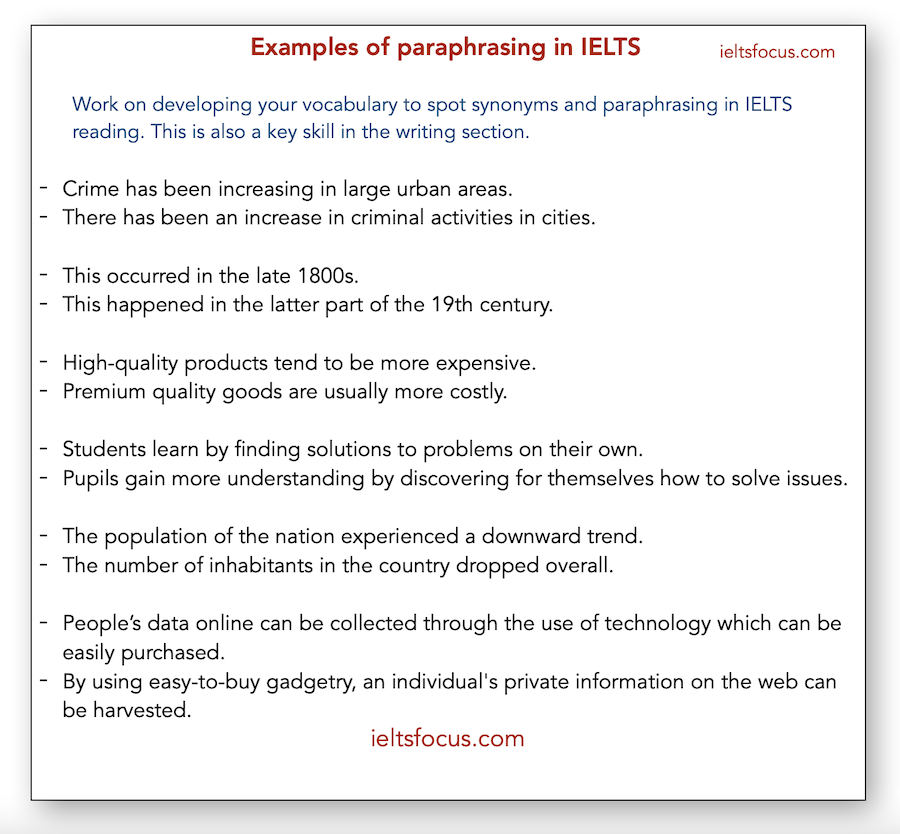
Example of ‘True False Not Given’ statements.

Common mistakes.
1. Spending too much time trying to find the answer for a Not Given question – Don’t spend too long looking all over the text for the answer. The questions are in order so do not waste time looking through the whole passage
2. Thinking that ‘False = the information doesn’t match‘ – This is not the case: ‘False = The information is the opposite’
3. Focusing on keywords and then trying to match them – you have to think of how the words from the statement are paraphrased and the way synonyms are used. Nearly always the words used in the statements are different from the answer in the text.
4. Thinking that you have to be an expert on the topic -or needing to understand every single word, sometimes you will not understand technical words but you can get a good idea of the meaning by guessing the meaning from context. Take a look at this Youtube lesson on guessing meaning.
5. Not fully understanding the statement. You need to understand what the question or statement asks, this is why your vocabulary has to be good before approaching this exam.
Practice and analysis.
Here are parts of a passage from a free online reading test by The British Council.
- Chronobiology is the study of how living things have evolved over time.

2. The rise and fall of sea levels affect how sea creatures behave.
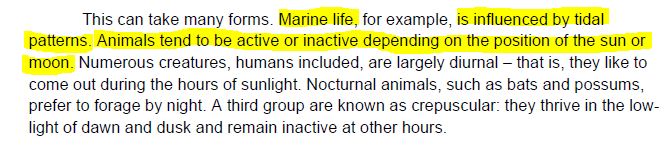
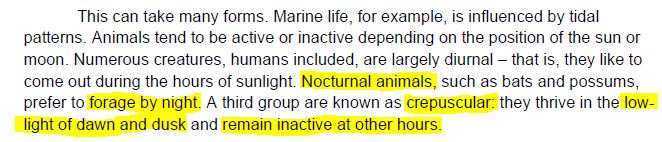
3. Most animals are active during the daytime.
Leave a comment below if you have any questions